My research examines the economics of digital platforms, AI, and innovation. In one stream, I study mobile app design, platform governance, and the economic impacts of AI — including algorithmic collusion and AI-driven market entry. In a second stream, I study industry and firm-level outcomes, including strategic technology partnerships, knowledge flows, and ICT-driven transformation. Methodologically, I combine econometrics, natural language processing, reinforcement learning, and network analytics.
Feel free to contact me if you are interested in any of these projects.
Journal Publications

Information Systems Research, 2025 · Vol. 36(3):1846–1870
Should app developers follow their own instincts or act on user feedback? We find that developer-led novel features and user-suggested imitative features drive demand — but blindly following user suggestions for novel features can backfire.
Firms strive to improve their products over time to compete effectively in the market. Typically, firms update their products by adding novel or differentiating features or by imitating competitors. With the ubiquity of social media, there is also the opportunity to obtain customer input on their preferred features for a product. In the case of mobile apps, user feedback in the form of reviews may include suggestions of novel features or those that are already present in competing apps but not in the focal app. Leveraging the information contained in reviews and version release notes of iOS apps, we develop a deep learning–based natural language processing approach to identify four types of app features: developer-initiated novel, developer-initiated imitative, user-suggested novel, and user-suggested imitative. We evaluate the impact of these feature categories on app demand. Our results demonstrate that only developer-initiated novel and user-suggested imitative features help increase app demand. We also find that the impact of user-suggested novel features is negative. However, this negative effect is limited to features that are contextually distant from user suggestions, whereas contextually close implementations have a positive effect. Although we observe that the aggregate impact of developer-initiated imitative features is statistically insignificant, features that are slightly modified from the original apps do have a positive effect on demand. The primary contribution of our study is to investigate user reviews as a source of ideas for new features and to evaluate their performance impacts relative to those of developer-initiated features.
@article{karanam2025follow,
title = {Follow Your Heart or Listen to Users? The Case of Mobile App Design},
author = {Karanam, Subrahmanyam Aditya and Agarwal, Ashish and Barua, Anitesh},
journal = {Information Systems Research},
volume = {36},
number = {3},
pages = {1846--1870},
year = {2025},
publisher = {INFORMS},
doi = {10.1287/isre.2023.0060}
}
Information Systems Research, 2025· Vol. 36(1):344-369
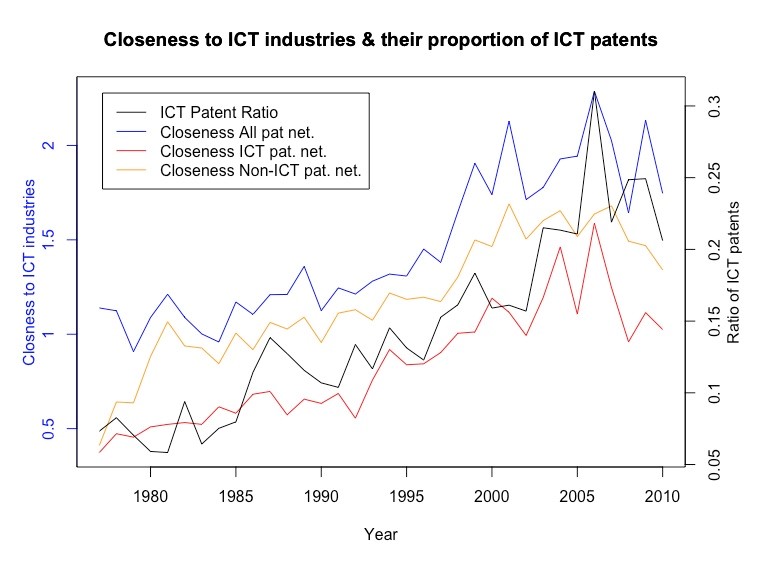
Using 1.3 million U.S. patents, we show that industries growing closer to ICT innovate more efficiently and create more new products but also face highly turbulent winner-take-all competition.
We create an intersectoral citation network using 1.3 million patents granted between 1981 and 2010 across all industries in the United States. In this network space, we find a significant increase over time in the proximity of non–information and communication technologies (ICT) industries to the ICT industry. Such “ICT-closeness” of an industry relates to a significant increase in the proportion of ICT technologies in the industry’s patent portfolio and complementarity between ICT and non-ICT patents in its portfolio. We hypothesize and find that ICT-Closeness has a significant positive impact on innovation outcomes of the citing industry, including innovative efficiency, recombinant capabilities, and creation of new products, services, and business methods. ICT-closeness also engenders hypercompetition in the citing industries, as reflected in greater winner-take-all dynamics and turbulence. Our results point to a paradigm shift in knowledge production, and in turn, sources of competitive value across diverse industries.
@article{karanam2025growing,
title = {Growing Technological Relatedness to the ICT Industry and Its Impacts},
author = {Karanam, Subrahmanyam Aditya and Mani, Deepa and Saha, Rajib},
journal = {Information Systems Research},
volume = {36},
number = {1},
pages = {344-369},
year = {2025},
publisher = {INFORMS},
doi = {10.1287/isre.2020.0627}
}
Information Systems Research, 2023 · Vol. 34(2):721–743
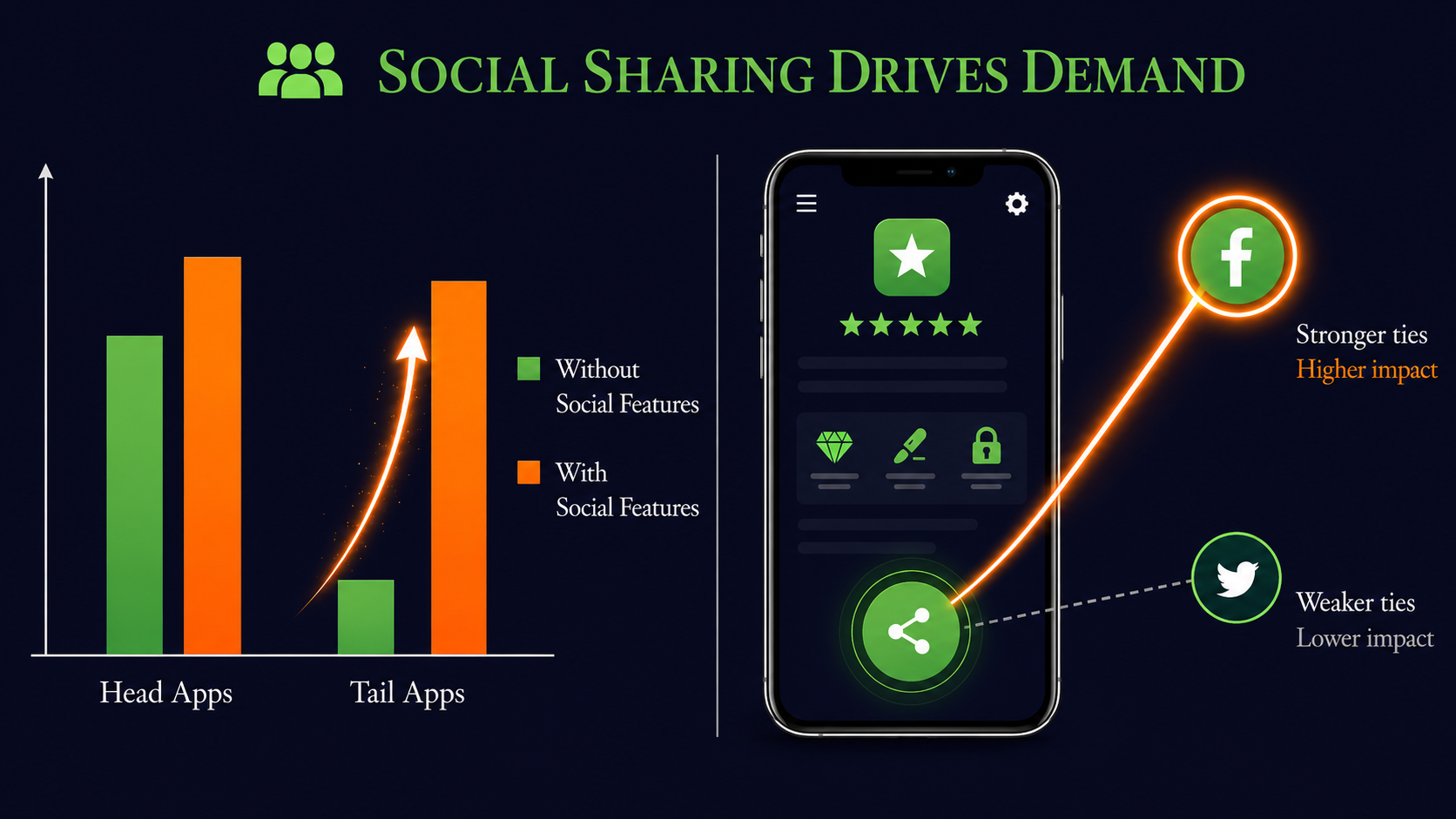
When should apps add social sharing features and which of them work best? We show that social features boost demand especially for niche apps, and work better on platforms with stronger social ties like Facebook than on Twitter.
With a large number of mobile apps on platforms such as iOS and Android, app developers face a significant challenge in generating market demand. Apps can incorporate social features to share information and create awareness. We focus on the impact of these features and their interplay with intrinsic features in the head, body, and tail of the demand distribution. Using a panel of version release notes from the iOS platform, we develop a novel hierarchical deep learning model to extract intrinsic and social features. Our results suggest that social features help increase the demand for tail apps and are also useful for head apps in informing users about new intrinsic features. To explore possible mechanisms, we analyze how different types of social features (personal and platform), intrinsic features (common versus differentiating), and app quality influence demand. We find that social features that allow sharing on platforms with large audiences are more effective at increasing demand than those on personal messaging systems. Furthermore, within platforms, social features perform better on those with stronger ties, such as Facebook as opposed to Twitter. Our analysis of different types of intrinsic features reveals that social features can help increase the demand for all apps when introduced with differentiating or less common intrinsic features. Furthermore, we find that there is a negative effect on the demand of tail apps when differentiating intrinsic features are combined with platform-based social features that have weaker ties. However, this negative effect is limited to low-quality tail apps only. Our results underscore the differences in the effect of different types of social and intrinsic features in various parts of the demand distribution. Our study provides managerial guidance to app developers in enabling social sharing through design choices and generating higher demand.
@article{karanam2023design,
title = {Design for Social Sharing: The Case of Mobile Apps},
author = {Karanam, Subrahmanyam Aditya and Agarwal, Ashish and Barua, Anitesh},
journal = {Information Systems Research},
volume = {34},
number = {2},
pages = {721--743},
year = {2023},
publisher = {INFORMS},
doi = {10.1287/isre.2022.1151}
}
Working Papers
Do strategic technology partnerships cause firms’ stock prices to move together? We find that strategic IT outsourcing creates economic interdependencies that drive significant comovement in market returns and fundamentals—not only between direct partners, but also across closely connected firms.
We find that the stock market valuations of firms reflect information on their technology partnerships and that market performance and fundamentals of firms comove with peers engendered by these partnerships. Using granular, proprietary data on 22,040 technology outsourcing contracts implemented between 1989 and 2013, we document that the implementation of a strategic technology partnership situates the focal client and vendor in a larger community of clients and vendors with interdependent risks and payoffs that results in performance comovement within these communities. We further find that the portfolio of contracts of the focal firm, notably, compensation modes, moderates their comovement with the community. Fixed price [variable price] contracts, where the vendor [client] bears the risk of cost overruns and is the residual claimant of ex-post surplus, insulate the client [vendor] from performance shocks. Our results show that the stock market values technology partnerships and recognizes peer groups engendered by these partnerships that are not reflected in standard industry groupings. The results additionally support the potential shift in competition from between firms to between value networks.
@unpublished{karanam2024comovement,
title = {Comovement of Stocks in Technology Partnerships},
author = {Karanam, Subrahmanyam Aditya and Mani, Deepa and Saha, Rajib and Srikanth, Kannan},
note = {Under Revision at Information Systems Research},
year = {2024},
url = {https://papers.ssrn.com/sol3/papers.cfm?abstract_id=3534561}
}
Platform promotions do more than shift user attention, they also shape product design. We find that platform initiated promotions trigger competitor imitation, leading to design convergence and greater demand concentration in the market.
Digital platforms such as Apple’s iOS App Store regularly promote selected apps. Prior research shows that such promotions influence user demand through attention spillovers to competing apps. We examine whether promotions also shape developers’ design choices and, if so, how the resulting design changes influence demand across the distribution, product variety, and demand concentration. We examine these questions using a panel dataset obtained from the iOS App Store spanning the years 2017 to 2023. We implement a hierarchical deep learning model to extract features of an app from its version release notes and use these features to measure the design similarity between promoted and competing apps. Subsequently, we estimate the effect of app promotions on the similarity of competing apps to the promoted apps, and in turn, the impact of this similarity on their demand. Our results show that promotions induce imitation rather than innovation: both incumbent competitors and new entrants add features similar to those of promoted apps. Increased design similarity increases demand primarily for popular non-promoted apps, while less popular apps are more likely to imitate. Overall, platform-initiated promotions lead to design convergence and demand concentration within a category. These findings uncover a novel design spillover mechanism beyond attention spillovers and suggest that platform promotion efforts may inadvertently reduce product differentiation, with important implications for platform governance and developer strategy.
@unpublished{karanam2024promotions,
title = {Increasing Demand While Hurting Innovation? The Curios Case of Mobile App Promotions},
author = {Karanam, Subrahmanyam Aditya and Agarwal, Ashish and Barua, Anitesh},
note = {Working Paper},
year = {2024},
url = {https://papers.ssrn.com/sol3/papers.cfm?abstract_id=5007683}
}
Artificial Intelligence, Collusion and Ad Auctions
Can AI bidding algorithms collude without explicit coordination? We show that budget-constrained AI bidders in first-price ad auctions systematically collude and advanced AI algorithms make it worse. Counterintuitively, more auction transparency facilitates rather than prevents collusion.
The rapid growth of Artificial Intelligence (AI) has led to its widespread deployment in automating decision-making and growing concerns about tacit collusive behavior among AI algorithms. One application involves real-time bidding for display advertisements, where collusion among bidders can negatively impact auctioneer revenues. Our study investigates this issue by analyzing the behavior of budget-constrained deep Q-learning algorithms in Firstprice auctions (FPA) through simulated computational experiments. We also examine how the advancement of AI technology and data policies affect the competitiveness of the auction. Overall, we find collusion among algorithmic bidders to be prevalent in FPA. The competitiveness of auctions further diminishes with more advanced AI algorithms. Contrary to findings in the literature on AI bidding with no budget constraints, our results suggest that when advertising platforms provide more detailed information about the auctions, it facilitates collusive behavior among budget-constrained AI bidders. We observe that this collusion is primarily sustained by the increased ability of AI agents to reward and punish competitor algorithms based on their previous bids and their tendency to stick to these strategies when more information is available regarding the competitors’ bidding behavior. Our results highlight the impact of using AI-powered algorithms on the outcomes in FPA and call for revisiting their design in order to enforce competitive behavior. Our findings also emphasize that the use of AI algorithms in display advertising auctions can potentially increase consumer surplus on the platform by reducing advertisement costs for firms.
@unpublished{karanam2024aicollusion,
title = {Artificial Intelligence, Collusion and Ad Auctions},
author = {Karanam, Subrahmanyam Aditya and Agarwal, Ashish and Barua, Anitesh and Hao, Daniel Tao Wei},
note = {Working Paper. Best Student Paper Runner-Up, WISE 2024},
year = {2024}
}
Connecting People and Spreading Ideas: Unraveling the Impact of Ride-Hailing on Knowledge Flows
Ride-hailing services like Uber don't just connect people, they also reduce knowledge barriers between firms. Using the staggered entry of ride-hailing services across U.S. counties, we find that improved urban mobility significantly increases local knowledge flows and collaborative patenting, especially for firms farther apart and those with weaker prior innovation output.
This study examines how ride-hailing services affect localized knowledge flows among firms. Leveraging the staggered entry of Uber and Lyft across U.S. counties between 2005 and 2019, we construct a panel dataset of within-city patent citations to measure inter-firm knowledge exchange. Using a difference-in-differences design, we find that the entry of ride-hailing services significantly increases local knowledge flows. Mechanism analyses suggest that this effect operates through improved urban mobility: the entry of ride-hailing increases local traffic flows and facilitates interactions among geographically separated firms. Consistent with this mechanism, the effect is stronger for firms located farther apart and for firm pairs that experience greater travel-time reductions when using car-based transportation. Additional analyses show that ride-hailing's entry also increases collaborative patenting and disproportionately benefits firms with weaker prior innovation output. Overall, our findings highlight how mobility-enhancing digital platforms can reduce communication frictions and foster localized knowledge exchange and innovation.
@inproceedings{deng2025connecting,
title = {Connecting People and Spreading Ideas: Unravelling the Impact of Ride-Hailing on Local Knowledge Flows},
author = {Deng, Jingyuan and Karanam, Subrahmanyam Aditya and Qiao, Dandan},
booktitle = {ICIS 2025 Proceedings},
year = {2025},
number = {11},
url = {https://aisel.aisnet.org/icis2025/sharing_econ/sharing_econ/11}
}
Work in Progress
Generative AI Dilemma: Enhancing Productivity While Managing Technical Debt in Open Source Software Development
Does GenAI help or hurt open source software quality? We examine how AI-assisted coding boosts short-term productivity but may accumulate technical debt that slows long-run development.
Adding Features vs. Fixing Bugs: The Delicate Balance of Innovation and Reliability in Mobile App Development
When should developers prioritize new features over fixing existing bugs? We study this tradeoff in mobile app development and its consequences for user retention and app store rankings.